
School Supplies Project
From Pens to Possibilities: The Role of Essential School Supplies in Cambodian Classrooms
In Cambodia, the educational success of children hinges on the availability of basic school supplies. These tools, though often taken for granted, are fundamental to learning. Pens, pencils, and notebooks are vital for students to engage in writing, note-taking, and practice across various subjects. Essential tools like rulers, erasers, and geometry sets play a crucial role in subjects such as mathematics and technical drawing. Meanwhile, durable school bags and art supplies enable students to transport materials and explore their creativity.
Meanwhile, durable school bags and art supplies enable students to transport materials and explore their creativity. Unfortunately, due to widespread poverty, many students lack these necessary supplies, which significantly hampers their educational progress. Through its school supplies initiative, Kamboo Project is committed to providing essential school supplies to children in need.
Background: The impact of school supplies on education in Cambodia
In Cambodia, children’s learning and educational opportunities are closely linked to the availability of essential school supplies. While access to these supplies varies by region and school, there are certain basic items that students across the country consistently depend on.
Pens and pencils are crucial tools for students, used not only to complete assignments but also for tasks like note-taking, drawing, and solving mathematical problems. Notebooks are necessary for taking notes, completing homework, and practicing various subjects such as mathematics, science, the Khmer language, and English. To correct mistakes made during writing or drawing, students use erasers and sharpeners, while rulers are essential for drawing straight lines, measuring distances, and creating geometric shapes—particularly in subjects like mathematics and technical drawing.
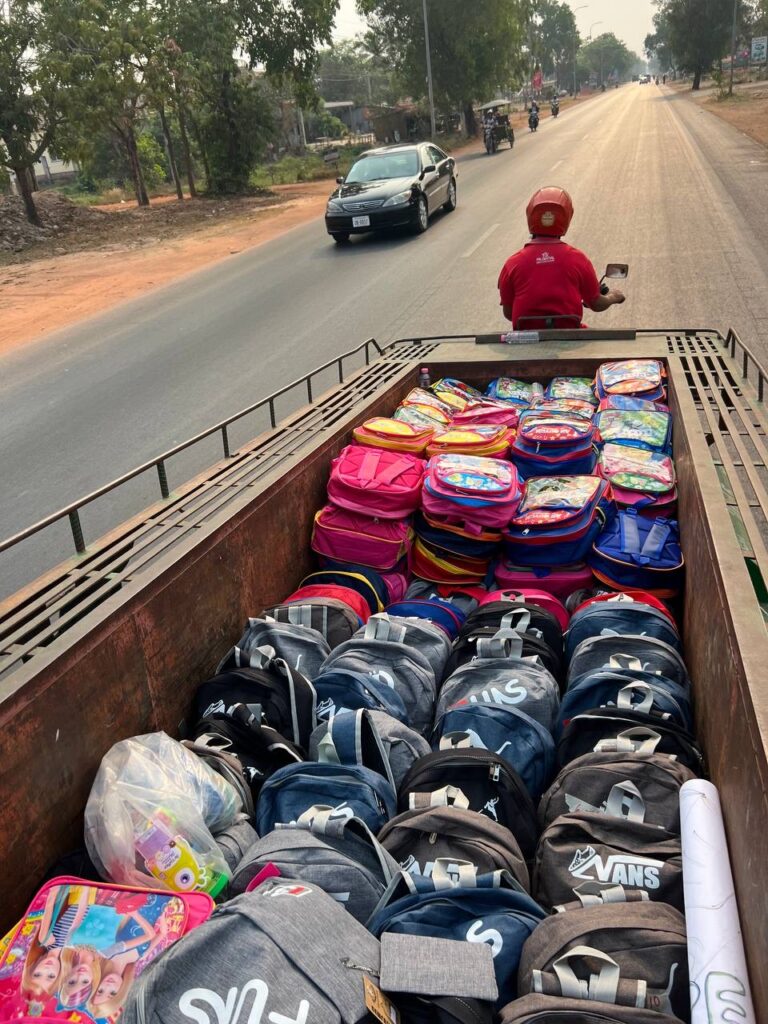
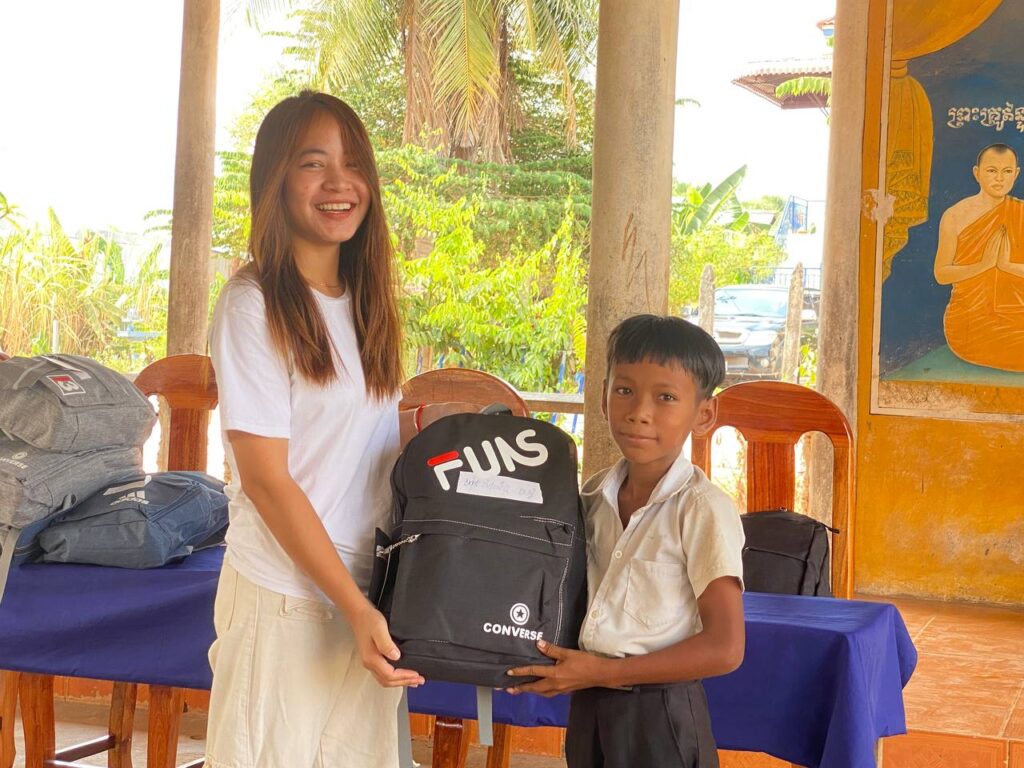
School bags are designed to be durable and easy to carry, enabling students to transport books, notebooks, and other materials to and from school. Geometry sets, which typically include a compass, protractor, and set squares, are commonly used for making precise measurements and drawings in technical drawing and geometry classes. Calculators, especially basic scientific models, are frequently required for mathematics and science courses to assist with computations and problem-solving.
Art materials, such as colored pencils, crayons, watercolor paints, and sketchbooks, allow students to express their creativity and develop artistic skills during art classes. Scissors and glue are indispensable for various craft projects and presentations, helping students complete hands-on tasks. While not always classified as school supplies, backpacks and water bottles are commonly used by Cambodian students. Backpacks make it easier for students to carry their belongings, and water bottles help them stay hydrated throughout the school day.
Due to widespread poverty, many children lack these crucial supplies, which hinders their ability to learn effectively.
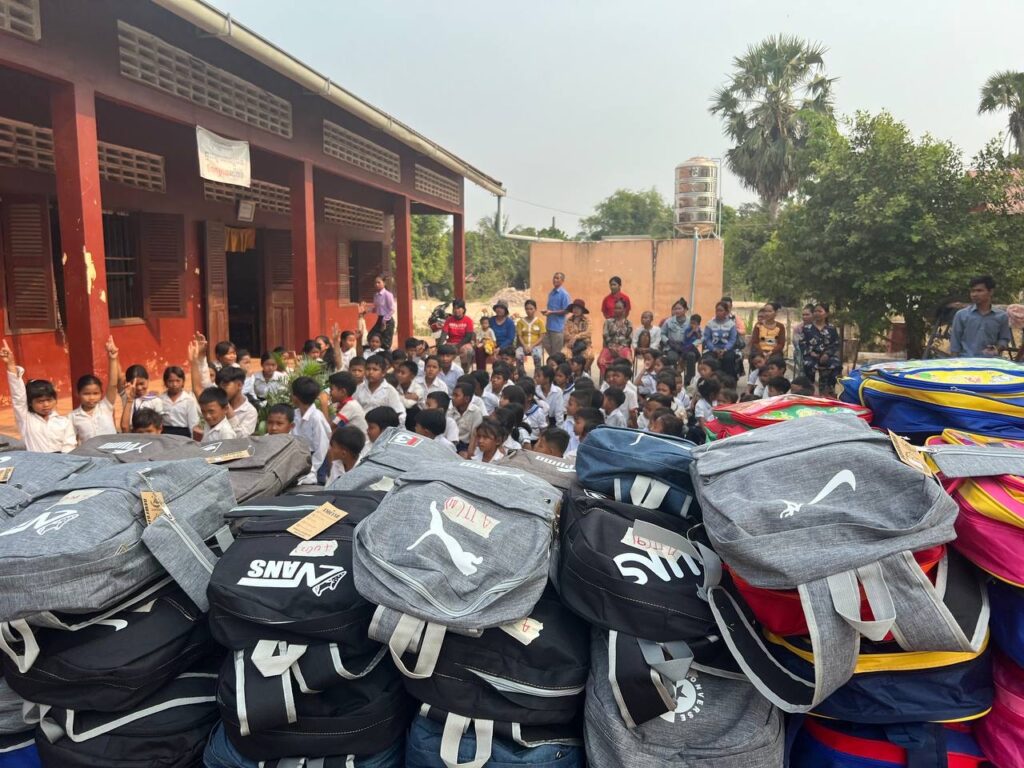
Beyond the classroom: The fight for school supplies in Cambodia’s remote areas
In Cambodia’s rural areas, numerous challenges related to school supplies can significantly hinder children’s access to education. The following issues are commonly encountered:
1. Limited Availability:
Due to factors such as remote locations, poor infrastructure, and restricted distribution networks, rural communities often struggle with limited access to adequate school supplies. This scarcity can result in a shortage of essential items like notebooks, pens, and pencils.
2. Affordability:
Many families in rural Cambodia face financial difficulties, making it hard to afford school supplies. The cost of these materials, when combined with other educational expenses, can be prohibitive, leaving children without the tools they need to succeed in school.
3. Lack of Facilities:
Some remote schools lack the necessary facilities to store school materials properly. This absence of storage can make it difficult to preserve supplies, leaving them vulnerable to damage or loss.
4. Inadequate Distribution Networks:
Delivering school supplies to isolated rural areas is often hampered by inadequate distribution networks. This can lead to delays in receiving supplies or, in some cases, a complete absence of necessary materials.
5. Cultural and Linguistic Barriers:
In certain remote areas, cultural or linguistic barriers may complicate the acquisition or use of appropriate school supplies. For example, the lack of materials and textbooks in students’ native languages can make it more challenging for them to engage effectively with the curriculum.
6. Lack of Awareness:
In some instances, rural families and communities may not fully recognize the importance of providing their children with adequate school supplies. This lack of awareness can result in a lower priority being placed on obtaining and maintaining essential materials.
7. Insufficient Support:
Students in rural areas may face additional challenges due to limited support from the government or nonprofit organizations. Without proper assistance, it becomes more difficult for these children to acquire the necessary resources for their education.
Project Description
The project will select 50 vulnerable students from disadvantaged families in Prasat Bakong District, Siem Reap province, Cambodia.
Our selection criteria for recipients:
1. Children with disabilities (physical impairment)
2. Children who live more than 4 km away from school
3. Poor children (parents are holders of an IDPoor Equity Card)*
4. Children living under difficult circumstances (violent domestic family, parental divorce, children separated from one parent due to work restrictions).
5. Children who are about to drop out of school and need help with transportation
*) Equity Cards are provided to poor households as a means to access social assistance services, facilitated through the Identification of Poor Households Programme (IDPoor). About the Identification of Poor Households Program in Cambodia | IDPoor
Items and Budget
Here are the details of the items that each of the 50 students will receive as a set for the academic year:
| No. | Items | Qty | Price | Amount | Total | $50.00 |
|---|---|---|---|---|
| 1 | Exercise books | 20 | $0.15 | $3.00 |
| 2 | Pens and pencils | 20 | $0.10 | $2.00 |
| 3 | Eraser and sharpener | 10 | $0.15 | $1.50 |
| 4 | Set of rulers | 1 | $1.50 | $1.50 |
| 5 | Art suppiles | 1 | $8.00 | $8.00 |
| 6 | Geometry sets | 1 | $2.00 | $2.00 |
| 7 | Calculator | 1 | $3.00 | $3.00 |
| Total | $21.00 | |||
| 8 | Uniform | 2 | $8.00 | $16.00 |
| 9 | Backpack and water bottle | 1 | $13.00 | $13.00 |
The project will select the 50 most in-need students in Prasat Bakong District, Siem Reap province. Below is the budget for the entire cohort of 50 students:
| No. | Items | Qty | Price | Amount | Total | $3,000.00 |
|---|---|---|---|---|
| 1 | A uniform set (skirts/shorts and shirts) | 50 | $16.00 | $800.00 |
| 2 | Basic school supplies (books, pencils, erasers, rulers, bags) | 50 | $21.00 | $1,050.00 |
| 3 | Backpacks and water bottles | 50 | $13.00 | $650.00 |
| 4 | Transport general administrative costs | 1 | $500.00 | $500.00 |
Current Status of the Project
This project has been running since 2014 and is one of the earliest project groups. Almost all (47 of 52) KP schools have had students selected, with thousands of students benefiting. This project is repeated at every school when new first-grade students begin the school year and whenever new students join higher grade levels.