
Bicycle repair project
Revitalizing Rides: Paving the Path for Sustained Education Access
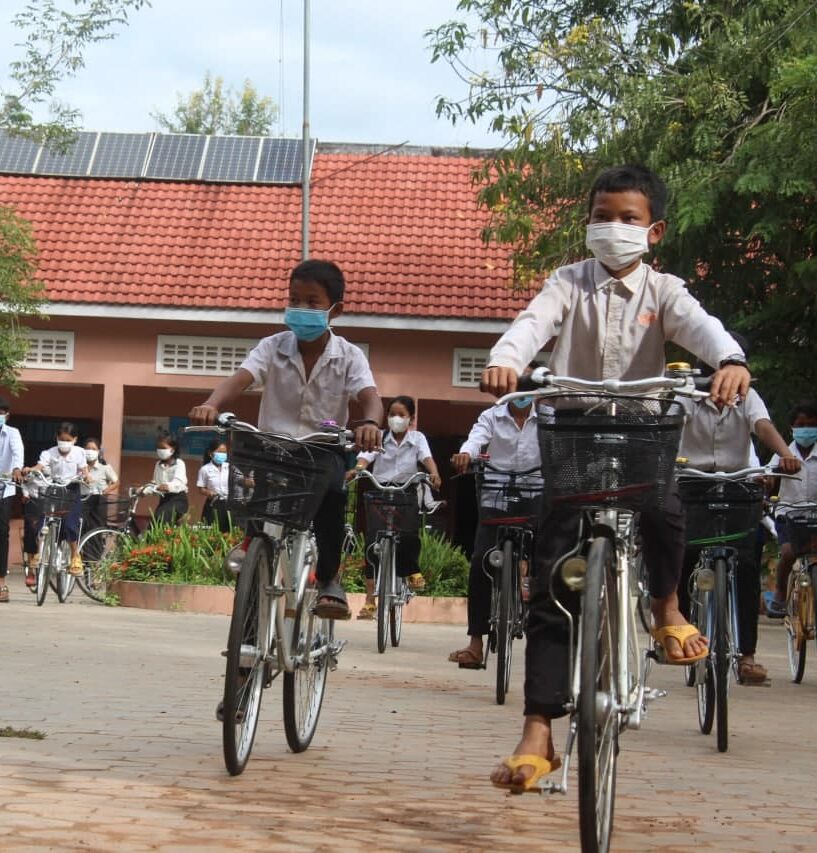
Despite providing bicycles to rural children, ensuring continuous access to education remains a challenge due to the inevitable wear and tear that these vital tools undergo, sooner or later rendering them inoperable. Kamboo Project’s innovative approach pivots from solely distributing new bicycles to implementing a dedicated repair and spare parts replacement initiative, facilitating smoother paths to learning for more than 10,000 students across 52 primary schools in the Prasat Bakong District.
Background
Riding towards education with bicycles as tools for access
In many developing countries, accessing education remains a formidable hurdle for rural children. Donors and NGOs have addressed the challenge by providing something as seemingly simple yet transformative as bicycles. These humble yet potent vehicles serve as conduits of hope, bridging the gap between aspirations and access.
Such interventions aim to enhance educational attainment and ameliorate dropout rates within the country. Notably, a substantial volume of bicycles is annually disbursed to rural children, empowering them to embark on their educational journeys.
Central Challenge
Broken bikes, broken paths to education
While buoyed by the prospect of new bicycles for children’s educational support, Kamboo Project acknowledged that distributing bikes by itself is not enough. What about when these bikes encounter issues?
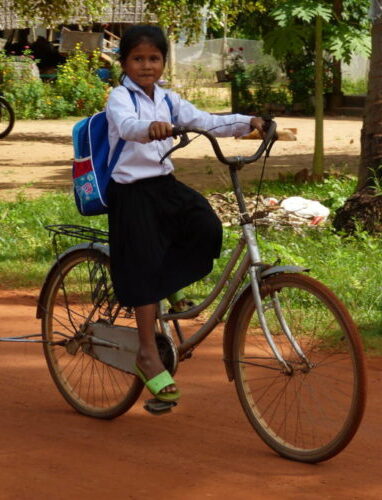
Obtaining the necessary spare parts locally or at repair facilities poses a significant challenge for recipients, particularly given that many of the bicycles provided by NGOs are second-hand imports from Japan. As a result, Kamboo Project found a significant number of bicycles inoperable due to a scarcity of spare parts in local communities, particularly in rural areas. This shortage has led to decreased bicycle usage and school dropouts – not because beneficiaries are unwilling to repair them, but due to the systemic lack of spare parts and bicycle repair infrastructure. Consequently, many rural children simply abandon their bikes once they incur damage.
Strategy
Sustaining education access through bike maintenance
Kamboo Project aims to decrease the dropout rate among schoolchildren through a novel initiative—repairing bikes within the Siem Reap province. Our new strategic plan diverges from merely supplying new bikes to children. Instead, it centers on resolving issues on the ground by replacing spare parts, leading to substantial cost savings and more sustainable outcomes.
For instance, while a new bike typically costs $60, our project spends an average of $10 per bike for repairs, allowing us to allocate $60 to support six bikes – the equivalent of aiding six children.
Additionally, the project will assess older bikes that are beyond repair, and in such cases, Kamboo Project will provide new bikes as replacements, ensuring that children maintain the opportunity to access education with dignity and reliability.
Implementation and monitoring
Partnering with 52 primary schools in the Prasat Bakong District of Siem Reap, the project impacts the lives of 11,250 students. Our selection process prioritizes families facing the greatest need, identified through Equity Cards. Furthermore, we conduct comprehensive evaluations of each student’s and family’s socioeconomic circumstances following their request submission, ensuring targeted and impactful support.
[1] Equity Cards are provided to poor households as a means to access social assistance services, facilitated through the Identification of Poor Households Programme (IDPoor). About the program to identify poor households in Cambodia | IDPoor
Budget
If implemented, the Bicycle Repair Project would require a total funding target of close to $2.500 per school and the proposed budget would look as follows:
| No. | Project Activities | Budget details | Budgeting per school | Total Project Budget Estimation | per school | $2.472 |
|---|---|---|---|
| 1 | Establish school repairing bike management committees in each targeted school. | 1 school per day * $6 per day * 2 staff members | $12 |
| 2 | Formulate roles and responsibilities for these committees, securing acknowledgment from the district education department. | 1 school per day * $6 per day * 2 staff members | $12 |
| 3 | Conduct mapping and consultations with schoolchildren to assess the extent of bicycle repair needs at each school. | 1 school per day * $6 per day * 2 staff members | $12 |
| 4 | Collaborate with local university volunteer students and key stakeholders to orchestrate bike repair campaigns within targeted project areas. | 1 school per day * $6 per day * 2 staff members | $12 |
| 5 | Nominate school teachers and students to lead bike repairs post-campaign. | 1 school per day * $6 per day * 2 staff members | $12 |
| 6 | Arrange training sessions with local bike shop experts for teachers and student representatives. | 1 trainer * $50 per half day + $3 per half day * 2 staff members | $56 |
| 7 | Coordinate with school principals and teachers to allocate storage space for bike spare parts. | 1 school per day * $6 per day * 2 staff members | $12 |
| 8 | Procure spare parts to distribute among teachers and students tasked with bike maintenance. | $1,000/school | $1.000 |
| 9 | Allocate spare parts to schools post-campaign based on each school's number of bikes. | $100 per month * 12 months per school | $1.200 |
| 10 | Implement supervision and monitoring measures to ensure adherence to project plans and frameworks across all participating schools. | $6 per day * 2 staff members *12 months (visiting once per month) | $144 |
Support Kamboo Project
Join us in ensuring every bike remains a gateway to education for Cambodian children!