
Single parents scholarship project
From Stigma to Success: Educational Aid for Children of Single Parents in Cambodia
Single parents in Cambodia face stigma and discrimination, which limit their opportunities for employment and financial stability. As a result, they struggle to provide for their children’s basic needs, including their education.
Children from single-parent families often face significant challenges in accessing education. Single mothers and fathers may lack the resources to cover school fees, uniforms, and other essential expenses. They frequently encounter financial difficulties, limited support, issues with childcare, geographic barriers (such as living in rural areas), and gender discrimination, particularly for girls pursuing higher education.
The Single Parents Scholarship Project aims to address these challenges by providing financial assistance, resources, and support to children of single parents.
Background: Breaking the 15% dropout barrier
According to data from the UNESCO Institute for Statistics, the primary school completion rate in Cambodia was 84.6% in 2018. This means that more than 15% of primary school-aged children do not complete their primary education. The lower secondary school completion rate was 50.2% in the same year, indicating that around half of lower secondary school-aged children do not follow through with their education.
Several factors contribute to the high dropout rates in Cambodia:
1. Poverty:
Poverty is a primary factor contributing to high dropout rates. Families living in poverty may struggle to afford school fees, uniforms, and other education-related expenses. Additionally, children from poor families often have to work to support their families, making regular school attendance challenging. This issue is especially pronounced in rural areas, where poverty rates are higher and access to education is more limited.
2. Distance to the schools:
The distance to schools is a significant barrier. Many schools are located far from rural communities, making regular attendance difficult for children. The lack of transportation options further exacerbates this issue, as children cannot easily reach schools that are far away.
3. Lack of access to basic services:
The absence of basic services, such as clean water and sanitation facilities, contributes to high dropout rates. Without access to these services, children may fall ill and miss school or feel uncomfortable attending regularly.
4. Gender discrimination:
Gender discrimination particularly affects girls. Girls are often expected to help with household chores or care for younger siblings, hindering their ability to attend school regularly. In some families, there is also a preference for educating sons over daughters, further disadvantaging girls.
5. Lack of qualified teachers and resources:
Many schools in Cambodia lack qualified teachers and adequate resources, making it difficult for children to learn and stay engaged in their studies. The shortage of educational materials and support negatively impacts the quality of education.
6. Social and cultural factors:
Social and cultural factors also play a role in high dropout rates. For instance, ethnic minority groups may face discrimination and have limited access to educational opportunities. Additionally, some families prioritize work or marriage over education for their children, leading to higher dropout rates.
In addition to all these factors, children of single parents are doubly disadvantaged because there is only one working parent in the household.
Project description
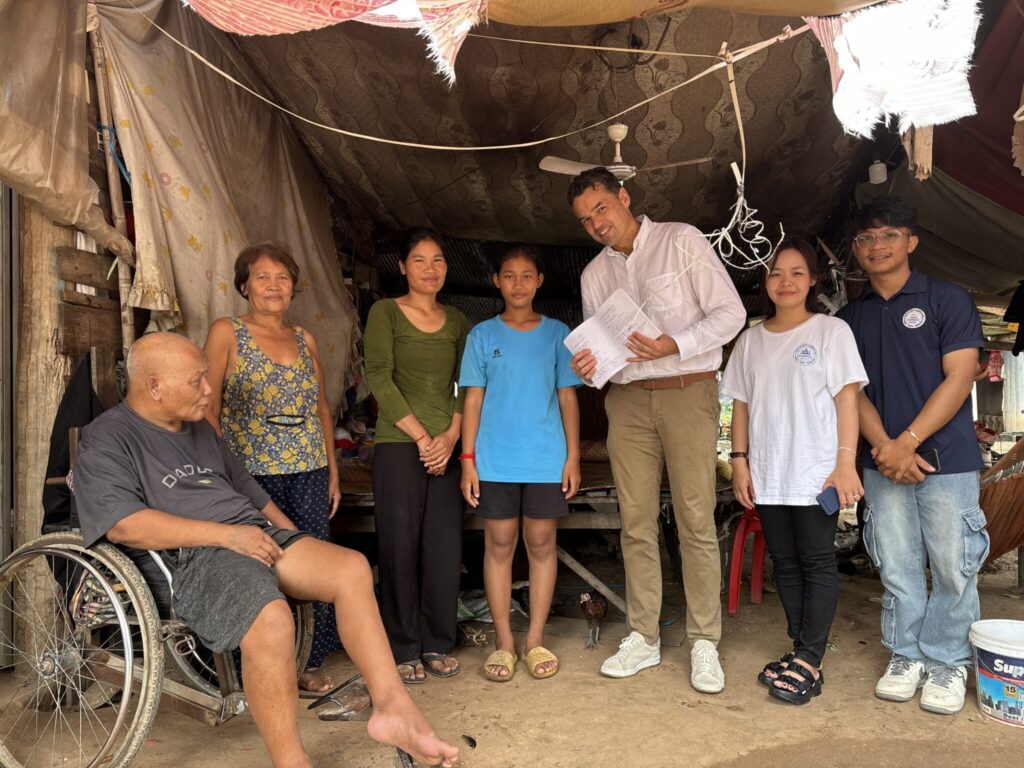
Kamboo Project launched a brand new program in 2023 specifically for children of single parents, and we’re proud to have already sponsored scholarships for two lucky students.
The sponsored students will gain comprehensive knowledge, positive attitudes, and practical skills in the following areas:
- Leadership and management
- Job position and career development
- English proficiency
- Computer literacy
- Balancing community and office work
- Environmental and health management
Course program
Eligible students from the rural areas of Siem Reap will be selected to join the program. The project will sponsor these students’ education from primary school through university.
Below is an overview of the course contents:
| No. | Content | Theory (hours) | Practice (hours) | Class Status | Total | 399 | 95 |
|---|---|---|---|---|
| 1 | English Proficiency (English File Pre-Intermediate Upper-Intermediate ) | 120 | In-person | |
| 2 | Interpersonal Communication Skills | 9 | Online | |
| 3 | Organizational, Critical Thinking, and Presentation Skills | 15 | 6 | In-person |
| 4 | Essay Writing Skills | 15 | 10 | In-person |
| 5 | Introduction to Photo Shooting Skills | 3 | 3 | In-person |
| 6 | Technology and Social Media | 6 | 6 | Online |
| 7 | Computer Literacy (MS Word, Excel, and PowerPoint) | 72 | 50 | In-person |
| 8 | English for Business | 30 | Online | |
| 9 | English for Communication | 30 | Online | |
| 10 | Basics of Psychology Counseling Skills | 15 | In-person | |
| 11 | Health and WASH Education (Physical Health, Mental Health, Clean Water…) | 15 | In-person | |
| 12 | Climate Change and Environmental Education | 15 | Online | |
| 13 | Foundations of Leadership Management Skills | 15 | In-person | |
| 14 | Fundraising Concept | 15 | In-person | |
| 15 | Job Hunting, CV Writing, and Cover Letter Writing Skills | In-person | ||
| 16 | Inspirational Speech by a Role Model | 15 | In-person | |
| 17 | Campus University/Career/Job Fair Visit (NGOs, Companies, Universities…) | 9 | In-person | |
| 18 | Applied Community (Fieldwork) Practice | 40 | In-person | |
| 19 | Applied Project Assignment-Based Topic | Individual | In-person |
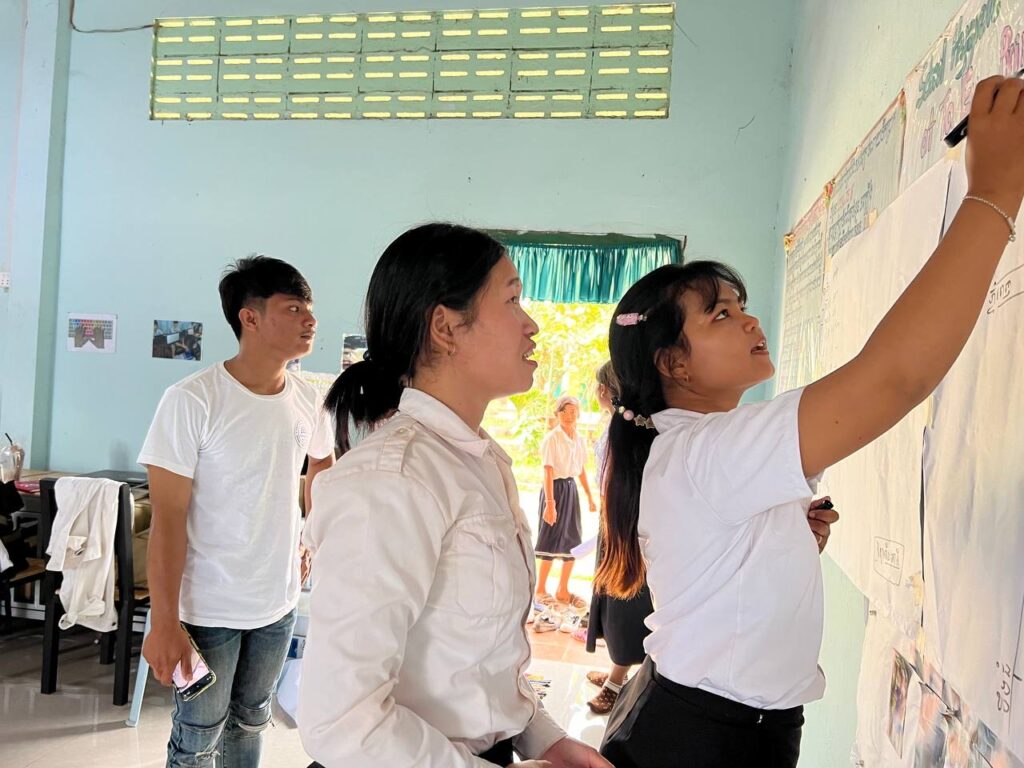
Graduated students will demonstrate:
- English proficiency to at least an upper-intermediate level and effective communication in English within the Cambodian market.
- Comprehensive knowledge of career development and professional writing in the workplace.
- A strong understanding, attitude, and practice in community fieldwork and office environments.
- Increased IT literacy and the ability to apply it effectively for internal and external communication.
- A strong ability to apply a teamwork approach in various professional settings.
Process for identifying recipients of a scholarship and for keeping the benefits:
Enrollment criteria and timing
- Primary school to university students from our project area
- Outstanding result in Khmer lessons (among the top 10 in the class)
- Outstanding result in English lessons (among the best 5 in the class)
- Children of single parents
- Family of student with ID-Poor-Card status
Entitlement to keeping scholarship award over time
- State school: above 90% attendance rate per month
- Additional teaching: comments and written feedback from teachers must express support for students
- Kamboo project Sunday lessons: > 90 % attendance per month
- Semesterly results of exams: > 70/100 points or > 30/50 points in each subject
The benefit
Full scholarship
Each scholarship recipient for grades 7 to 12 will receive:
- One bicycle per school cycle
- Two school uniforms per year
- Stationary supplies for one year
- $15 USD monthly allowance per subject for extra class fees
- 3 subjects for grade 10
- 4 subjects for grade 11
- 5 subjects for grade 12
- $5 USD monthly allowance for daily personal meals
- $5 USD monthly allowance for their family
- Extra Sunday morning classes provided by Kamboo Project on English, computer, financial literacy and leadership (pending Kamboo Project’s availability)
- For high school, we provide $600 towards fees. If the school’s fees are higher, we will work with the family to assist them further or help them find employment to contribute to the additional costs (self-help option)
Budget for a scholarship for grades 7-12
| No. | Description | Qty | Price | Amount | Total | $690.00 |
|---|---|---|---|---|
| 1 | Uniform | 2 | $25.00 | $50.00 |
| 2 | Bije | 1 | $70 | $70 |
| 3 | Study supplies | 12 | $10 | $120 |
| 4 | Extra class fee | 10 | $15.00 | $150.00 |
| 5 | Daily meal | 12 | $5.00 | $60.00 |
| 6 | Monthly cash allowance | 12 | $5.00 | $60 |
| 7 | Family visitation | 12 | $15.00 | $180.00 |
University scholarship
- One bike per course cycle
- Two school uniforms per year
- A computer/laptop at the beginning of the first year
- $25 USD worth of stationary supplies per year
- $5 USD monthly allowance for daily personal meals
- $5 USD monthly allowance for her or his family
- Additional Kamboo Project Sunday morning classes in English, computer training, financial literacy and leadership (subject to Kamboo Project availability)
- $600 for the annual university fee per year, and if the school charges a higher fee, we will work with the family to support them further or help them find a job to cover the additional costs (self-help option)
Budget for a university scholarship
| No. | Description | Qty | Price | Amount | Total | $1,670.00 |
|---|---|---|---|---|
| 1 | Uniform | 2 | $25.00 | $50.00 |
| 2 | Bije | 1 | $70.00 | $70.00 |
| 3 | Study supplies | 12 | $25.00 | $300.00 |
| 4 | Daily meal | 12 | $5.00 | $60.00 |
| 5 | Monthly cash allowance | 12 | $5.00 | $60.00 |
| 6 | Family visitation | 12 | $15.00 | $180.00 |
| 7 | Computer | 1 | $350.00 | $350.00 |
| 8 | University fee | 1 | $600.00 | $600.00 |
Termination of the scholarship
Kamboo Project reserves the right to cancel the payment of the grant and/or is entitled to terminate our scholarship program for the following reasons:
- If the scholarship holder does not regularly attend Khmer classes and supplementary courses (unless he or she has prior authorization or the missed classes are due to illness).
- If the scholarship holder fails his/her examinations (monthly examinations or examinations at the end of the semester).
Warning period: A scholarship recipient’s family will receive two warnings and thus opportunities to improve the above points before a scholarship is finally terminated.
Transparency obligation
- Progress reports in video format are sent to the donor every semester (June and December).
- Scholarship holders – with the support of Kamboo Project – are asked to contact their own donor at least three times a year and give him/her an update on study progress and results, as well as send an informal postcard for their birthday and Khmer New Year.
Kamboo Project coordinates and decides on the timing and the final communication channel (video, Facebook, email).